


RUBBER BIOREFINE IMAGING
See inside rubber. Compound by compound.
Understanding what a rubber material actually contains, and how those compounds are distributed spatially, is not always straightforward. Conventional analytical methods give averages. Rubber BioRefine Imaging gives location.
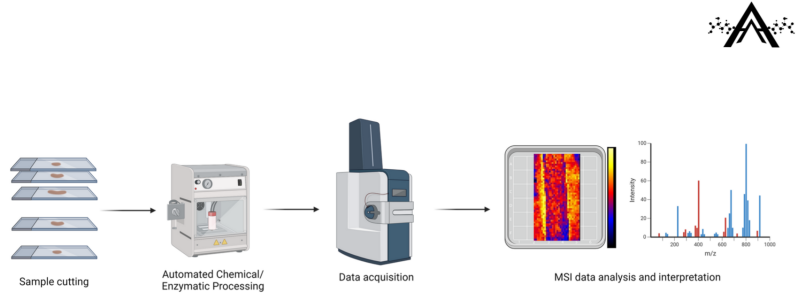
Using MALDI-MSI (Matrix-Assisted Laser Desorption Ionisation Mass Spectrometry Imaging), we generate precise spatial maps of compound distribution within rubber samples. The result is molecular visibility that conventional methods cannot provide, revealing not just what is present, but where, and in what concentration.
WHAT WE IMAGE
Three core applications in rubber
Rubber polymer distribution: A full polymer fingerprint of tire or recycled rubber material, spatial location of polymer types, chain distribution patterns, and mass spectrometry analysis of repeating unit distributions. Helps teams evaluate formulation consistency, validate raw material quality, and identify blending irregularities.

Imaging polymer distribution patterns

Mass spectrum: polymer repeating unit distribution
Carbon black characterisation: Precise assessment of how carbon black, virgin or recovered, disperses within rubber matrices. Maps distribution uniformity, surface chemistry variations, and contamination from other ingredients. Gives manufacturers the molecular evidence needed to qualify recycled carbon black alternatives with confidence.

Distribution of carbon black units within tire sections

Mass spectrum: carbon black lattice distribution
Antiozonant mapping: Detailed spatial analysis of antiozonant concentration and migration throughout the rubber matrix. Reveals distribution uniformity, compound migration before and after curing, and potential leaching zones. Helps manufacturers optimise protective compound placement and evaluate next-generation alternatives with molecular precision.

Heatmap of 6PPD distribution within a tire segment. Highest concentration is found near the edges of the section.

Mass spectrum: PPD signal
COMPLEMENTARY CAPABILITY
Chiral Imaging
For applications where molecular handedness matters, Akin also offers chiral imaging, combining ion mobility spectrometry with high-resolution mass spectrometry to spatially separate and visualise mirror-image molecular structures within complex rubber samples. Available on request for specialised analytical needs.
WHERE IT APPLIES
Built for rubber. Applied across the value chain.
Rubber BioRefine Imaging is relevant at multiple points in the rubber value chain: from compound development and quality assurance in tire manufacturing, to feedstock characterisation and output verification in recycling operations.
Whether you're evaluating new compounds, characterising recycled feedstock, or building an evidence base for regulatory compliance, we'd be glad to talk. Get in touch!